
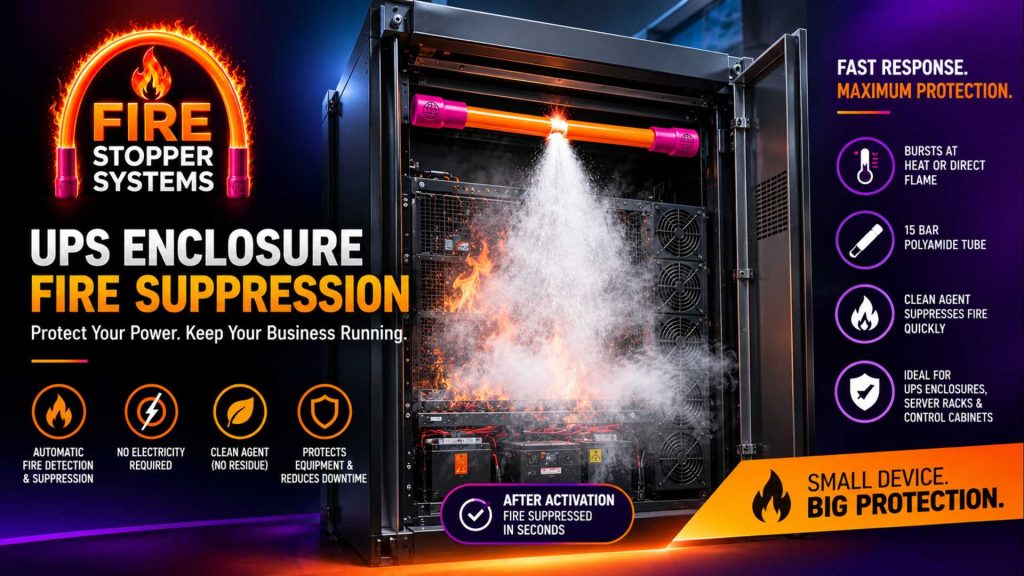
Uninterruptible power supply (UPS) systems play a critical role in protecting computers, servers, telecommunications equipment, industrial controls, and other essential electrical infrastructure. When utility power fails, a UPS keeps connected equipment operating long enough to maintain continuity, transfer to backup power, or safely shut down.
But the UPS itself can become a fire risk.
Electrical faults, overheating components, damaged wiring, battery failures, and other equipment problems can create a fire inside a UPS cabinet or battery enclosure. Because these fires can begin inside enclosed equipment, traditional room-level fire protection may not detect or suppress the fire at the earliest possible point.
That is where UPS enclosure fire suppression can provide an additional layer of protection.
An automatic tube fire suppression system places a heat-sensitive suppression tube directly inside the protected enclosure. When the tube reaches its specified activation temperature, it can rupture at the hottest point and discharge extinguishing agent directly toward the fire source.
Fire Stopper Systems describes its tube system as a passive, heat-activated solution that does not require an electrical detection circuit.
UPS enclosure fire suppression is a localized fire protection approach designed to protect the interior of a UPS cabinet, battery cabinet, or similar electrical enclosure.
Instead of waiting for smoke or heat to leave the equipment enclosure and reach a remote detector, an enclosure-level system places the detection mechanism directly where a fire could develop.
A typical tube-based system uses a pressurized, heat-sensitive tube installed inside the protected equipment. The tube acts as both the detection mechanism and, in direct configurations, the agent delivery mechanism.
When localized heat reaches the tube’s specified activation temperature, the tube ruptures at the heated area. The resulting opening allows the extinguishing agent to discharge directly at or near the source of the fire.
This approach can be particularly useful for equipment where a fire may start in a confined cabinet before it becomes visible from outside.
For larger installations, system configuration, agent quantity, tube routing, enclosure volume, and application requirements should be evaluated by a qualified fire protection professional.
UPS equipment combines electrical power conversion, batteries, wiring, circuit protection, and other components within a relatively confined space.
Under normal operating conditions, these systems are designed to operate safely. However, electrical equipment can still experience faults or abnormal heat conditions.
Potential fire hazards may include:
The challenge is that a fire inside a UPS cabinet may not immediately be visible to personnel or detectable by a room-level system.By the time smoke or heat reaches a conventional room detector, the fire may already have damaged critical components. An enclosure-level suppression system provides another layer of protection by placing the detection tube directly inside the equipment. This does not replace the facility’s overall fire protection strategy. Instead, it can complement room-level detection and suppression systems by addressing the equipment enclosure itself.
A UPS enclosure fire suppression system is designed to respond directly inside the cabinet where a fire may begin.
The pressurized suppression tube remains installed inside the UPS enclosure and continuously monitors the surrounding temperature. Because the tube responds to heat mechanically, the detection function does not depend on an electronic smoke detector or conventional electrical detection circuit. This is an important consideration for electrical equipment because a fault that creates a fire may also interrupt electrical power.
If a component begins overheating or a fire develops, the temperature surrounding the tube increases.
The tube is positioned within the enclosure so that it can respond to heat from potential fire sources.
Proper tube placement is an important part of system design and should be based on the enclosure configuration and protected equipment.
When the tube reaches its specified activation temperature, the heat-sensitive material ruptures at the point where the highest temperature is present.
Fire Stopper Systems states that its automatic tube systems can activate through heat without an electrical connection. Its published application information lists an activation range of approximately 90°C to 110°C for certain electrical enclosure applications.
The exact activation specification should always be confirmed for the particular system and application.
Once the tube activates, the extinguishing agent is discharged directly toward the area where the tube ruptured.
In a direct system, the agent is stored within the pressurized tube itself. In an indirect configuration, the tube functions as the heat-triggering mechanism while an external cylinder supplies the extinguishing agent.
Direct discharge allows the suppression agent to be delivered at the point where the heat condition was detected.
The objective is to suppress the developing fire before it can spread to additional UPS components, wiring, batteries, or surrounding equipment.
The effectiveness of any suppression system depends on correct system selection, agent type, enclosure characteristics, installation, and applicable design requirements.
| Feature | UPS Enclosure Protection |
| Detection method | Heat-activated suppression tube |
| Activation | Direct thermal activation |
| Electrical power | Not required for tube activation |
| Suppression method | Direct discharge at the heat source |
| Agent | Clean extinguishing agent, application-specific |
| Residue | Designed for low/no conductive residue, depending on agent |
| Installation | Inside the UPS enclosure |
| Applications | UPS cabinets, battery cabinets, electrical enclosures |
| System type | Direct or indirect configuration |
| Maintenance | Inspection and servicing according to manufacturer requirements |
Fire Stopper Systems states that its tube acts as both the detection and delivery mechanism in its direct configuration. Because activation is heat-based, the tube does not depend on an electrical detection circuit to initiate operation.
The appropriate agent, tube configuration, quantity, and installation method should be determined according to the specific enclosure and applicable fire protection requirements.
A UPS enclosure system and a room-level fire suppression system serve different purposes.
| Protection Type | Room-Level System | UPS Enclosure System |
| Protects the room | ✓ | ✓ |
| Protects inside the UPS cabinet | Limited | ✓ |
| Detects heat at equipment level | Limited | ✓ |
| Requires electrical detection | Often | No electrical power required for tube activation |
| Discharges directly inside enclosure | No | ✓ |
| Designed for enclosed electrical equipment | Limited | ✓ |
| Suitable for battery cabinets | Depends on system | Application-specific |
A room-level fire suppression system protects the wider facility.
An enclosure-level system focuses on the equipment itself.
This distinction is particularly important in facilities where UPS equipment supports critical infrastructure.
Examples include:
A room-level system may be essential for protecting occupants, the building, and surrounding equipment. An enclosure-level system can provide an additional layer of protection closer to the potential ignition source.
The two approaches should be viewed as complementary rather than interchangeable.
UPS battery cabinets can contain significant amounts of stored electrical energy in a confined enclosure.
A battery-related fault, damaged component, overheating condition, or electrical failure can create a fire risk inside a cabinet that may be difficult to access from outside.
An enclosure-level suppression system places the detection tube close to potential ignition areas, providing localized fire protection alongside the facility’s broader fire protection strategy.
Lithium-Ion UPS Battery Considerations
Lithium-ion battery systems require particular attention because fire behavior can vary significantly depending on battery chemistry, cell construction, enclosure design, thermal management, ventilation, and system configuration.
A suppression system should not be selected based solely on the fact that an installation uses lithium-ion batteries.
Instead, the design should consider:
For lithium-ion applications, the appropriate fire protection strategy should be specified for the actual battery system.
No fire suppression technology should be represented as a universal guarantee against thermal runaway or battery re-ignition without application-specific testing and supporting data.
A tube-based system can respond directly to elevated temperature without relying on an electronic detection circuit.
This provides a passive detection approach inside the protected enclosure.
The heat-sensitive tube can remain operational even when an electrical fault affects the equipment.
This is especially relevant to UPS and electrical cabinet applications because the event that creates a fire may also disrupt electrical power.
The extinguishing agent can be released at the location where the tube reaches its activation temperature.
This creates a localized response rather than requiring a remote detector to identify the fire first.
Clean-agent suppression can provide an alternative to water-based discharge in sensitive electrical environments.
The suitability of a particular extinguishing agent depends on the protected equipment, enclosure, fire hazard, concentration requirements, and applicable standards.
Suppression tubing can be routed within electrical cabinets and other enclosed equipment.
This allows fire protection to be incorporated without requiring the same physical space associated with a large room-level suppression installation.
UPS systems often support equipment where downtime can have operational and financial consequences.
Localized suppression can provide another layer of protection aimed at limiting the consequences of an enclosure fire.
The technology can be considered for a range of enclosed electrical applications, subject to proper system design.
Potential applications include:
Protect the interior of UPS equipment where electrical and power conversion components are housed.
Provide localized protection for battery enclosure applications following an appropriate risk assessment.
Protect electrical components housed within enclosed panels.
Tube-based systems can be configured for certain switchgear and electrical cabinet applications. Fire Stopper Systems specifically describes tube installation inside electrical panels and switchgear enclosures.
Enclosure-level suppression can also be considered for server racks and other equipment where a fire can begin inside an enclosed space.
PLC, VFD, HMI, relay, and other control cabinets can contain electrical components that require localized fire protection.
Not every UPS installation has the same enclosure volume, fire hazard, or protection requirements.
Tube suppression systems can be configured differently depending on the application.
In a direct system, the suppression tube contains the extinguishing agent.
The tube is installed inside the protected enclosure. When the tube reaches its activation condition and ruptures, the agent is released directly from the opening.
This type of configuration may be appropriate for smaller enclosed equipment when supported by the system’s design specifications.
An indirect system uses the heat-sensitive tube to detect the fire while an external cylinder supplies the extinguishing agent.
When the tube activates, the system releases the agent from the connected cylinder.
This configuration can be considered for larger enclosures or applications requiring a greater quantity of suppression agent.
The correct configuration depends on enclosure size, hazard type, agent requirements, system specifications, and applicable standards.
Choosing the right system requires more than selecting a tube and installing it inside a cabinet.
A proper application review should consider:
The internal dimensions and volume of the UPS or battery cabinet affect system selection.
Identify the components most likely to generate excessive heat or create an ignition source.
Electrical equipment, batteries, wiring, power conversion components, and other materials can present different fire hazards.
The extinguishing agent should be appropriate for the specific equipment and fire scenario.
The tube should be positioned to provide appropriate coverage of the highest-risk areas.
Determine whether a direct or indirect system is appropriate.
The installation should be evaluated against applicable codes, standards, manufacturer requirements, insurance requirements, and local regulations.
Correct installation is essential. Tube positioning, pressure, agent quantity, fittings, mounting, and system documentation all affect system performance.
Fire protection equipment should be selected and installed with applicable codes and standards in mind.
Fire Stopper Systems currently lists certifications and compliance information including UL Listed, FM Approved, NFPA Compliant, ISO 9001, CE Certified, and RoHS Compliant on its certifications page.
The exact certification or standard applicable to an installation depends on the product, agent, jurisdiction, equipment, and application.
For this reason, project owners and engineers should request the appropriate certification and compliance documentation for the specific system being considered.
Do not assume that a general certification automatically applies to every UPS, battery, or electrical installation.
For current certification information, see the Fire Stopper Systems certifications and compliance page.
A professional installation should begin with an assessment of the protected equipment.
The installer or engineer evaluates the UPS cabinet dimensions, internal components, access points, and potential fire hazards.
The suppression tube is positioned near components where excessive heat or fire is most likely to develop.
The appropriate direct or indirect configuration is selected based on the enclosure and suppression requirements.
The tube is routed and secured inside the enclosure according to the manufacturer’s installation requirements.
The system is checked to ensure that the tube, fittings, cylinder, pressure, and other components are correctly installed.
Installation and system documentation should be maintained for future inspections, servicing, compliance reviews, and insurance records where applicable.
Automatic fire suppression equipment should not simply be installed and forgotten.
Regular inspection and servicing help ensure that the system remains ready when needed.
Maintenance requirements can vary by system and installation, but inspection may include:
Any activated suppression tube or discharged system should be serviced or replaced according to the manufacturer’s requirements.
UPS systems exist to protect critical operations from power interruptions.
A UPS may support:
A fire inside the UPS can therefore create a second type of outage at precisely the wrong time.
Enclosure-level suppression addresses this risk by placing fire protection closer to the equipment itself.
Rather than relying exclusively on protection installed elsewhere in the building, organizations can evaluate whether localized suppression is appropriate for individual UPS and battery enclosures.
This equipment-level approach can become an important part of a broader fire protection and business continuity strategy.
UPS enclosure fire suppression is a localized fire protection system designed to detect and suppress a fire inside a UPS cabinet, battery cabinet, or similar electrical enclosure.
The tube is heat-sensitive. When the surrounding temperature reaches its specified activation condition, the tube ruptures at the heated location and releases the extinguishing agent in systems designed for direct discharge.
A heat-activated tube system does not require electrical power for the tube to detect heat and activate. This makes the approach particularly relevant to electrical equipment where a fire may occur during a power fault.
Battery cabinets can be considered for enclosure-level suppression, but the system must be selected according to the battery chemistry, cabinet design, thermal characteristics, agent requirements, and applicable fire safety requirements.
Lithium-ion applications require careful evaluation. Battery chemistry, enclosure design, thermal management, ventilation, and applicable testing and safety requirements should all be considered before selecting a suppression system.
No. Enclosure-level suppression and room-level fire protection address different protection objectives. A localized system should generally be considered as part of a broader fire protection strategy rather than an automatic replacement for facility-level protection.
A direct system releases agent from the activated tube itself. An indirect system uses the heat-sensitive tube to trigger the release of agent from a separate cylinder. The appropriate configuration depends on the protected enclosure and system requirements.
Yes, tube-based suppression systems are designed for certain enclosed electrical applications. Fire Stopper Systems specifically describes installations inside electrical panels, switchgear, control cabinets, and other enclosed equipment.
Inspection and servicing should follow the manufacturer’s requirements and any applicable codes, standards, jurisdictional requirements, and site procedures.
Certain clean agents are designed to minimize or eliminate residue, but the exact characteristics depend on the agent used. The selected agent should be verified for compatibility with the protected electrical and electronic equipment.
The correct system depends on the UPS enclosure dimensions, internal components, fire hazards, battery type, agent requirements, configuration, applicable standards, and installation requirements. A qualified fire protection professional should review the application before specification.
A UPS is designed to keep critical equipment operating when normal power fails.
But the UPS itself can become a source of risk if an electrical fault, overheating event, or battery-related problem develops inside the enclosure.
Adding automatic enclosure-level fire suppression gives the equipment another layer of protection directly where a fire may begin.
A properly specified tube-based system can provide passive heat detection and localized agent discharge without depending on an electrical detection circuit.
The right solution depends on the actual UPS or battery cabinet, its internal components, enclosure volume, fire hazards, battery technology, and applicable safety requirements.
Fire Stopper Systems can help evaluate your enclosure, determine the appropriate tube configuration, and provide specification and compliance information for your application.
Request a specification quote from Fire Stopper Systems.
Learn more about automatic tube fire suppression and how it can protect enclosed equipment: