
Enclosed electrical panels and machinery spaces cause a massive share of industrial fires across the United States. When an electrical fault sparks inside a sealed cabinet, traditional room ceiling sprinklers respond only after flames escape the enclosure. By that time, your equipment is ruined and production stops.
Automatic fire suppression systems solve this problem by stopping fires directly inside micro-environments within seconds. We design our Fire Stopper Systems tubes to detect heat and suppress fires instantly without external power.
An automatic fire suppression tube is a pressurized polymer tube that detects heat, bursts at a specific temperature, and discharges a clean fire-extinguishing agent directly onto the fire source within seconds without requiring electrical power
Our tube-based fire suppression system works as both a continuous detection sensor and a delivery nozzle. We pressurize the polyamide tubing to 15 bar (217 psi) using a clean extinguishing agent.
First, we route the flexible tube throughout the high-risk zones inside your enclosure. The tube stays close to potential failure points like circuit breakers, relays, and power supplies.
Next, when a fire starts, the heat builds up rapidly inside the enclosed space. As soon as the surface temperature reaches 100°C to 120°C (212°F to 248°F), the tube wall softens and bursts at the hottest spot.
Finally, the burst creates a micro-nozzle. The clean agent discharges instantly through this opening, cooling the heat source and smothering the flames before they spread.
We manufacture Fire Stopper Systems tubes to meet demanding industrial environments across the USA. Here are the core specifications:
The best uses for automatic tube fire suppression systems are enclosed micro-environments with high ignition risks, including electrical control cabinets, CNC machines, server racks, and vehicle engine bays where rapid, targeted fire suppression prevents catastrophic equipment loss.
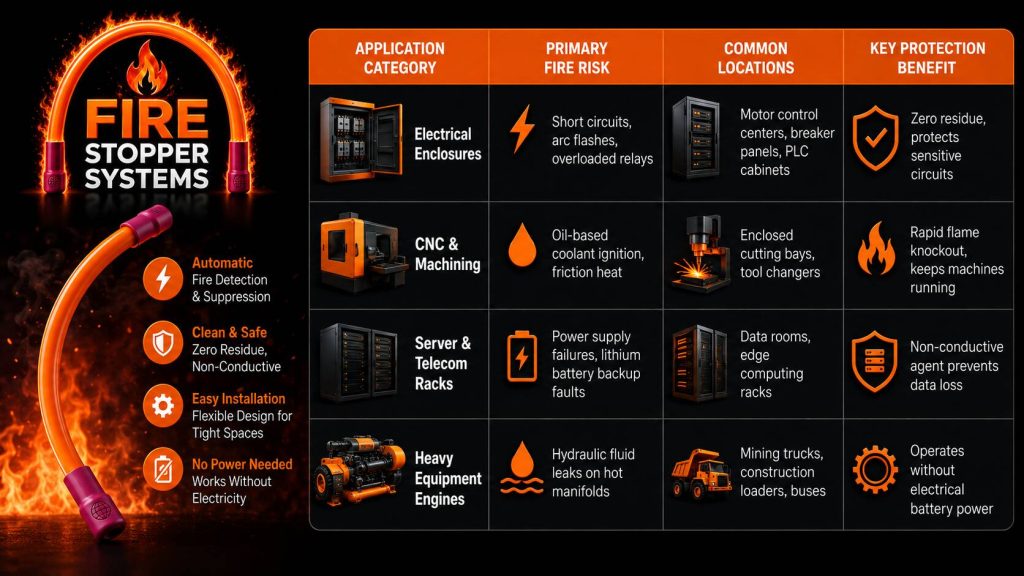
| Application Category | Primary Fire Risk | Common Locations | Key Protection Benefit |
| Electrical Enclosures | Short circuits, arc flashes, overloaded relays | Motor control centers, breaker panels, PLC cabinets | Zero residue, protects sensitive circuits |
| CNC & Machining | Oil-based coolant ignition, friction heat | Enclosed cutting bays, tool changers | Rapid flame knockout, keeps machines running |
| Server & Telecom Racks | Power supply failures, lithium battery backup faults | Data rooms, edge computing racks | Non-conductive agent prevents data loss |
| Heavy Equipment Engines | Hydraulic fluid leaks on hot manifolds | Mining trucks, construction loaders, buses | Operates without electrical battery power |
Electrical control cabinets represent the single most common application for our automatic fire suppression tube systems. Control panels contain dense arrangements of contactors, variable frequency drives (VFDs), and programmable logic controllers (PLCs).
First, loose connections or component age can create electrical arcing. These arcs quickly ignite wire insulation and plastic terminal blocks.
Next, because control cabinets are usually sealed to keep out dust, fires smolder quietly until they generate intense heat. A standard smoke detector outside the cabinet will not notice the fire until the enclosure doors warp or smoke leaks out.
Our tube-based fire suppression system routes directly above the circuit tracks and power distribution blocks. The moment an arc flash generates a thermal hotspot, the tube bursts directly above that component. The clean agent quenches the fire in under 5 seconds, saving the rest of the panel from damage.
CNC milling machines, lathes, and laser cutters use oil-based coolants and lubricants that ignite when tools break or friction spikes.
First, high-speed machining produces friction sparks. If a coolant pump fails or cutting oil runs dry, metal-on-metal contact creates instant ignition.
Next, modern CNC machines have enclosed work areas with powerful exhaust fans. These fans pull oxygen into the flame, turning a minor spark into an intense blaze within seconds.
Installing our automatic fire detection and suppression tube inside the cutting enclosure provides direct protection. The tube detects the sudden flame front near the spindle or oil tray, ruptures instantly, and fills the cutting chamber with clean agent. This protects your expensive five-axis spindles and stops fires from traveling up through the oil mist collection ducts.
Server cabinets and network enclosures house high-value IT equipment that cannot tolerate water or corrosive dry chemical powder.
First, server power supplies and rackmount uninterruptible power supplies (UPS) run continuously under heavy load. A failed capacitor or worn transformer can ignite surrounding components.
Next, facility-wide water sprinklers destroy servers and storage drives just as effectively as the fire itself. Even if the fire is small, water causes total hardware loss and permanent data corruption.
Our clean agent fire suppression for cabinets releases an electrically non-conductive gas that leaves no residue. It extinguishes the fire by removing thermal energy without short-circuiting live electronics or damaging delicate hard drive platters.
Heavy equipment in mining, construction, forestry, and public transit operates under extreme vibration, dirt, and heat conditions.
First, diesel engines run hot exhaust manifolds right next to high-pressure hydraulic lines. A single cracked hydraulic hose sprays atomized oil across a 500°C manifold, causing an immediate fireball.
Next, vehicle battery cables can short out during rough operations in quarries or construction sites. Operators might not notice an engine bay fire until smoke enters the cabin.
Our self-activating fire suppression tube installs directly along the upper engine compartment and hydraulic pump bay. Because our systems require no electrical power, they remain 100% active even if the machine’s battery disconnects or fails completely.
Micro-environment fire protection suppresses fires inside the specific equipment enclosure where they start, preventing downtime, structural damage, and secondary water destruction from building sprinklers.
Traditional water sprinklers protect the building structure, not your machinery. When a water head triggers at 68°C (155°F) at the ceiling, it dumps hundreds of gallons of water across your entire production floor.
Water destroys printed circuit boards, motor drives, and PLC processors on contact. Replacing an entire line of water-damaged control panels costs tens of thousands of dollars and takes weeks of re-wiring.
Our clean agent system confines the suppression event to the interior of the cabinet. The agent evaporates immediately after discharge, leaving your surrounding electrical components dry and undamaged.
Facility managers know that downtime costs far exceed the physical repair cost of a small electrical fire.
First, waiting for custom replacement control panels can stall an entire assembly line for months due to supply chain backlogs.
Next, cleaning dry chemical powder out of adjacent machinery requires days of manual scrubbing and testing. Dry chemical powder is corrosive and eats away at copper busbars and delicate contacts.
Our automatic fire suppression for electrical panels lets you recover fast. You simply fix the single faulted wire or relay, install a new Fire Stopper Systems tube, and restart your machinery on the same shift.
To choose the right tube-based fire suppression system, calculate the internal volume of your enclosure, evaluate internal airflow conditions, select the correct tube length, and match the activation temperature to normal operating ranges.
The volume of your cabinet dictates the amount of extinguishing agent needed to achieve total flooding concentration.
First, measure the height, width, and depth of your equipment cabinet in meters to find the total volume in cubic meters.
Next, select the corresponding tube length and diameter. For small junction boxes and compact drive bays under 0.5 cubic meters, a 1-meter or 2-meter tube provides complete protection. For large multi-door motor control centers up to 3 cubic meters, we supply longer 4-meter tubes or multi-tube configurations to ensure complete agent coverage.
Choosing the correct burst temperature prevents accidental discharges while ensuring fast response during a real thermal event.
Installing an automatic fire suppression tube requires routing the tube directly above heat sources using rubber-lined clips, maintaining correct bend radiuses, and checking the built-in pressure gauge periodically.
Proper tube placement guarantees fast fire detection. Follow these four installation rules:
Our tube systems do not need complicated annual recertifications or wiring checks, but routine visual inspections keep them ready.
First, check the integrated pressure gauge on the tube end cap every 30 days. The needle must rest in the green zone at 15 bar (217 psi).
Next, inspect the tube jacket every 6 months for signs of mechanical abrasion or chemical contamination from harsh cutting oils. If the pressure drops into the red zone or the tube shows deep cuts, replace the unit immediately.
An automatic fire suppression tube activates within 3 to 10 seconds after flame or concentrated heat contacts the tube wall. The localized rupture releases the extinguishing agent immediately at the exact point of ignition.
No, automatic fire suppression tubes are 100% pneumatic and mechanical. They do not use batteries, external wiring, or power supplies, which makes them operate during total electrical grid blackouts.
Fire suppression tubes use clean extinguishing agents such as FK-5-1-12 or HFC-227ea. These agents are non-conductive, non-corrosive, safe for sensitive electronics, and leave zero liquid or chemical powder residue after discharge.
You should visually check the pressure gauge monthly to ensure the needle remains in the green zone. We also recommend a hands-on physical inspection every six months to verify that mounting brackets are secure.
Do not wait for a small electrical fault to destroy your production schedule and cost your business thousands in lost inventory. We engineer Fire Stopper Systems automatic fire suppression tubes to provide 24/7 protection for your control cabinets, CNC machines, and critical equipment across the USA.
Contact our safety engineering team today to discuss your enclosure dimensions, get custom tube sizing, and protect your equipment before disaster strikes.