
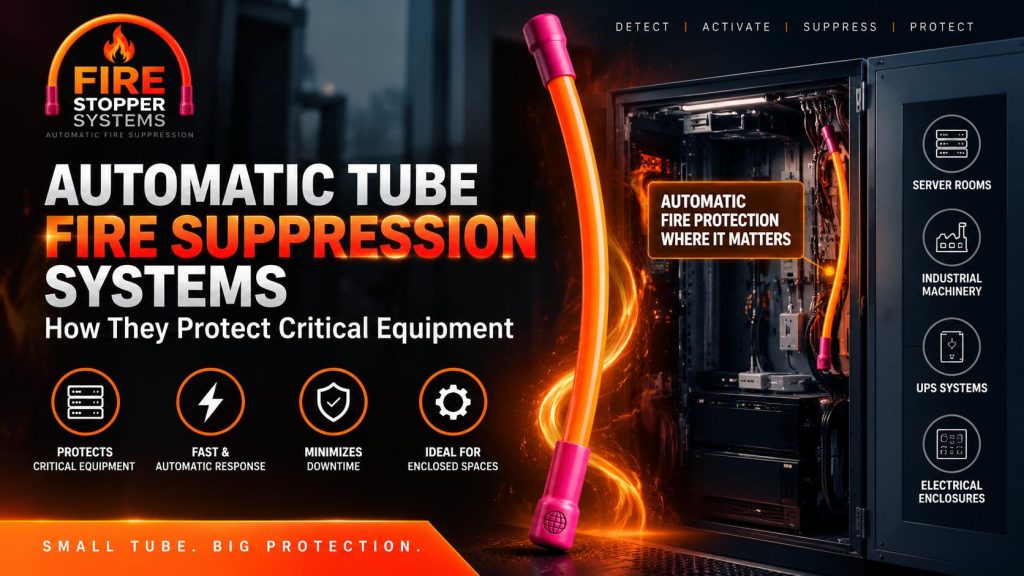
A fire inside an electrical panel, server rack, CNC machine, or generator enclosure can develop long before anyone notices smoke or flames outside the equipment.
Room-level fire alarms are essential, but they are designed to monitor the surrounding space. Portable extinguishers require someone to be present and able to respond. An automatic tube fire suppression system provides another layer of protection by detecting heat and releasing extinguishing agent inside the enclosure where the fire begins.
This guide explains what automatic tube fire suppression systems are, how they work, where they may be used, and what facility managers, equipment owners, installers, and system specifiers should confirm before selecting a system.
An automatic tube fire suppression system uses a pressurized, heat-sensitive tube installed inside or around protected equipment.
The tube performs two functions:
When the tube reaches its activation temperature, it ruptures at the hottest location. The extinguishing agent then discharges directly onto or near the developing fire.
Unlike a conventional system that may rely on electrical detectors, a control panel, wiring, or an external power source, a heat-activated tube system is designed to operate through heat and pressure.
That makes this type of protection useful for enclosed equipment where:
An enclosure system is not automatically a replacement for a building’s required fire alarm, sprinkler, or room-level suppression system. It is typically considered an equipment-level layer that addresses fire risk inside a specific cabinet, enclosure, or machine.
The operating sequence is straightforward.
The heat-sensitive tube is positioned near components where a fire could start. Depending on the application, this may include electrical connections, power supplies, motors, batteries, hydraulic areas, or other heat-producing components.
The exact routing depends on the enclosure’s size, layout, airflow, and equipment configuration.
A loose connection, component failure, electrical fault, overheating part, or other malfunction may create a concentrated heat source.
The surrounding air may still appear normal. A person outside the enclosure may have no indication that a problem is developing.
When the tube reaches its specified activation temperature, it opens at that location.
This localized activation is one of the central differences between tube-based protection and systems that detect conditions elsewhere in the room.
The agent is released through the opening in the tube and delivered directly into the protected enclosure.
Because the discharge occurs close to the source of heat, the system is designed to respond at the equipment level rather than waiting for smoke or heat to travel across a room.
Automatic tube fire suppression systems may be considered for many types of enclosed or partially enclosed equipment.
Electrical panels contain energized components, wiring, breakers, terminals, and connections. A fault inside the panel can create heat and ignition without producing an immediately visible external fire.
An enclosure-level system can provide localized protection inside the panel while the building’s broader fire protection systems monitor the surrounding area.
Important design considerations may include:
Server racks and telecommunications equipment can contain concentrated electrical loads and valuable hardware. A fire inside a rack can damage equipment, interrupt operations, and spread to nearby systems.
A tube-based system may be used as part of a broader data center fire-protection strategy. It should be evaluated alongside room detection, environmental monitoring, power management, airflow, and the facility’s emergency procedures.
CNC machines may contain electrical components, motors, lubricants, coolants, chips, and other combustible materials. A malfunction or overheating component can create a fire inside an enclosed machine before personnel recognize the problem.
Protection decisions should account for:
Generators and machinery may contain fuel, lubricants, electrical components, hot surfaces, and rotating equipment.
The correct suppression approach depends on the equipment type and the specific hazards inside the enclosure. A system should be sized and positioned for the actual machine rather than selected solely by equipment category.
UPS cabinets and battery enclosures contain electrical energy and heat-producing components. A fault inside a cabinet may not immediately affect the temperature or air quality of the surrounding room.
Battery chemistry, cabinet configuration, ventilation, and the facility’s existing safety controls should all be considered before specifying protection.
Marine engine compartments can be difficult to access quickly, particularly when equipment is operating away from shore. Heat-activated suppression may be considered for engine compartments and other enclosed marine equipment areas.
The system must be evaluated for the vessel, compartment volume, engine configuration, environmental conditions, and applicable marine requirements.
Telecommunications cabinets and equipment enclosures may operate continuously and remain unattended for extended periods. Localized automatic protection can help address fire risk in areas where immediate human response is unlikely.
Room-level fire protection and equipment-level fire protection address different conditions.
A smoke detector in a room must receive smoke from the fire. A suppression system protecting the room must discharge in a way that reaches the fire within that room. Neither approach necessarily places detection or agent directly inside a closed electrical enclosure.
An equipment-level system may help address this gap by:
This does not mean a tube system makes other fire-protection measures unnecessary. The right approach depends on the occupancy, equipment, hazards, applicable requirements, and authority having jurisdiction.
The tube is installed near the equipment being protected. It does not need to wait for smoke or heat to move across a room before activation.
The system is designed to use heat and pressure rather than depending on facility power, control-panel electronics, or a separate detection circuit.
That feature can be relevant when the equipment itself contains the power source or when a fire may affect electrical infrastructure.
The extinguishing agent is released inside the protected enclosure at the point where the tube activates.
This can reduce the distance between detection, discharge, and the developing fire.
A tube-based system may fit inside equipment where a larger piped arrangement or separate detection network would be difficult to install.
The available space and installation method still need to be reviewed for each enclosure.
Automatic operation matters when equipment runs after hours, sits in a remote area, or cannot be monitored continuously by staff.
Before selecting an automatic tube fire suppression system, request an application review based on the actual equipment.
Confirm:
Do not rely on a generic product description alone. A system that fits one electrical cabinet may not be suitable for a large battery enclosure, CNC machine, server rack, or marine engine compartment.
Fire Stopper Systems’ specific certification, listing, and code-related claims should be verified against current documentation before being included in a project specification.
Portable extinguishers remain an important part of many fire-safety programs, but they depend on human response.
Someone must:
That may not be possible when the equipment is unattended, energized, enclosed, remote, or already producing dangerous heat.
Automatic tube suppression is designed to respond without waiting for someone to discover the fire and open the enclosure. The two approaches may serve different roles and should not be treated as interchangeable without reviewing the application.
These systems may be used for equipment such as electrical panels, server racks, data center equipment, CNC machines, generators, UPS enclosures, machinery, marine engine compartments, and telecommunications equipment. Suitability depends on the specific enclosure and hazard.
A heat-activated tube system is designed to detect and release agent through heat and pressure, without requiring electrical power for the activation process.
Not necessarily. Equipment-level suppression and building-level systems address different risks. Confirm the required protection strategy with the project’s fire-protection professional and authority having jurisdiction.
A retrofit may be possible, depending on the equipment’s internal layout, available routing space, enclosure volume, and installation requirements. A project-specific review is necessary.
The agent depends on the product and application. [Confirm: Fire Stopper Systems’ current agent types and equipment-compatibility documentation.]
Follow the manufacturer’s inspection, service, and replacement instructions. [Confirm: published inspection and replacement intervals.]
A fire that starts inside critical equipment can remain hidden from room-level detection while damaging the components a facility depends on. An automatic tube fire suppression system adds localized detection and agent delivery inside the enclosure.
If you are evaluating protection for an electrical panel, server rack, CNC machine, generator, UPS, machinery enclosure, marine engine compartment, or telecommunications cabinet, provide the equipment details and operating environment for review.
Request a spec quote for an application-specific recommendation.