
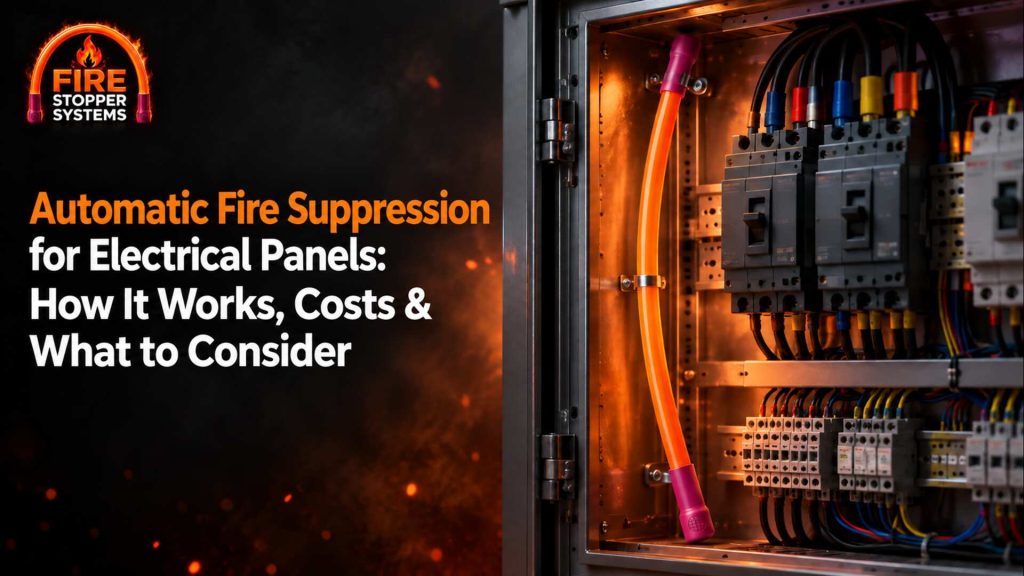
Electrical panels contain energized components that can generate significant heat when a connection fails, a component overheats, or an electrical fault occurs. If a fire starts inside an enclosed panel, detecting it early can help limit equipment damage, production downtime, and the risk of fire spreading to nearby equipment.
Automatic fire suppression for electrical panels is designed to detect and suppress a fire at or near its source inside an electrical enclosure. Unlike room-level fire protection, an enclosure-based system is positioned where the fire can actually start.
Fire Stopper Systems provides automatic tube-based fire suppression solutions for electrical panels, switchgear, control cabinets, and other enclosed equipment.
An automatic electrical panel fire suppression system is a compact fire protection solution designed to detect and suppress a fire inside an enclosure without requiring someone to manually activate the system.
A typical tube-based system uses a heat-sensitive detection tube installed inside the protected enclosure. When the tube reaches its activation temperature, it opens at the point exposed to the heat. Depending on the system configuration, the tube can either discharge the suppression agent directly or activate an external agent container.
This approach provides protection directly inside the equipment where a fire may begin.
Common applications include:
The correct system configuration depends on the equipment, enclosure size, potential fire hazards, suppression agent, and applicable installation requirements.
Electrical panels are designed to safely distribute and control electrical power. However, electrical faults can create conditions that may lead to overheating or ignition.
Potential causes include:
Loose terminals and connections can create increased electrical resistance. That resistance can generate heat and may damage surrounding components if the problem is not identified.
Breakers, contactors, relays, power supplies, drives, and other components can fail. A failed component may create excessive heat or an electrical fault.
Electrical equipment operating under heavy loads can generate heat. Poor ventilation, damaged components, or abnormal operating conditions can increase the risk.
A short circuit or other electrical fault can produce intense heat and potentially create an ignition source.
Older electrical equipment may have worn insulation, deteriorated components, or connections that require inspection and maintenance.
These risks make early fire detection important, especially in facilities where electrical equipment supports critical operations.
The basic process is designed to detect heat and release a suppression agent without waiting for a person to notice smoke or flames.
A fire or localized overheating event creates a high-temperature area inside the protected electrical panel.
The heat-sensitive tube is positioned near potential fire hazards. When the tube reaches its specified activation temperature, it ruptures at the heated point.
The system then releases the suppression agent according to its configuration.
In a direct system, the agent can be discharged through the activated tube into the enclosure.
In an indirect system, the tube functions primarily as the heat detection element and activates a separate discharge mechanism.
The suppression agent is released into the affected enclosure to suppress the fire.
This source-level approach is one of the main advantages of enclosure fire suppression. The system is designed around the equipment rather than relying only on detection at the room level.
For more information about the operating process, see the [How It Works] page on the Fire Stopper Systems website.
Two common approaches to tube-based enclosure protection are direct and indirect systems.
| Feature | Direct System | Indirect System |
| Detection tube | Detects heat | Detects heat |
| Agent discharge | Through the tube | Through separate discharge points |
| Typical use | Smaller enclosed equipment | Larger or more complex enclosures |
| System design | Compact | More flexible discharge arrangement |
| Installation | Depends on enclosure | Depends on enclosure and discharge layout |
The choice should not be based only on enclosure size. The equipment configuration, potential ignition points, suppression agent, required coverage, and manufacturer’s installation requirements should all be considered.
If you are unsure which configuration is appropriate, Fire Stopper Systems can review the application and provide guidance on the suitable system.
A facility may already have building-level fire detection and suppression. However, room-level protection and equipment-level protection serve different purposes.
A smoke detector in a room may identify a developing fire after smoke escapes from an enclosure. A sprinkler system protects the building based on its design and applicable requirements.
An enclosure-based suppression system is positioned inside the equipment itself.
That can provide several potential benefits:
The exact performance depends on system selection, installation, enclosure characteristics, suppression agent, and the specific fire scenario.
Automatic tube fire suppression can be considered for many types of enclosed electrical equipment.
Control panels contain electrical components that operate machinery, production systems, HVAC equipment, pumps, and other systems.
A fire inside the panel can interrupt the operation of the connected equipment.
Switchgear manages electrical distribution and protection. Because it can contain high-value electrical components, fire protection is an important consideration for many facilities.
MCCs contain equipment used to control motors and industrial processes. A fire can affect both the electrical equipment and the production process it supports.
PLC cabinets and automation systems often control critical production equipment. Protecting these enclosures can help reduce the impact of an internal fire.
Variable frequency drives can be found in industrial machinery, pumps, fans, conveyors, and other systems. A dedicated suppression system can be considered where the enclosure presents a fire risk.
ATS equipment is used to transfer electrical loads between power sources. Protection may be important in facilities where reliable power transfer is critical.
The appropriate fire protection design should always be based on the actual equipment and installation.
There is no single price that applies to every electrical panel fire suppression installation.
The final cost can depend on several factors, including:
A small control cabinet may require a very different system from a large industrial switchgear enclosure.
For this reason, a specification-based quote is more useful than a generic online price.
If you are planning protection for an electrical panel, provide the enclosure dimensions, equipment type, application, and other available details when requesting a quote.
Selecting an automatic fire suppression system requires more than choosing a cylinder and detection tube.
Determine what components could create the highest fire risk inside the enclosure.
This may include power supplies, drives, terminals, contactors, breakers, or other electrical components.
The dimensions and internal volume of the enclosure can affect system selection.
Provide accurate measurements when requesting a system specification.
The location of high-risk components matters because detection should be positioned appropriately for the application.
The suppression agent should be appropriate for the protected equipment and the expected fire type.
For electrical equipment, the potential impact of the agent on sensitive components should also be considered.
Fire suppression systems may be subject to manufacturer requirements, listing or approval conditions, local regulations, and applicable fire protection standards.
Do not assume that a product’s general certification automatically means every installation is compliant. Confirm the requirements for the specific product and application.
Even automatic systems should be inspected according to the manufacturer’s requirements.
Routine inspection can help identify damage, expired components, pressure issues, tube deterioration, or other conditions that could affect system readiness.
One useful feature of tube-based fire suppression is that heat detection can operate independently of the building’s electrical power when the system is designed for passive tube activation.
This can be important because an electrical fire may cause a power interruption.
However, the complete system design should be reviewed to understand which components require power and which functions operate mechanically or pneumatically.
Always verify the operating characteristics of the specific Fire Stopper Systems configuration being installed.
The potential for equipment damage depends on the suppression agent and system design.
For sensitive electrical and electronic equipment, the choice of suppression agent is especially important.
A properly selected system should be evaluated based on:
The goal is not simply to suppress the fire. The system should be appropriate for the equipment it is intended to protect.
These systems should not necessarily be viewed as replacements for building-level fire protection.
They address different protection needs.
Building fire protection can provide coverage for rooms, buildings, and occupied areas.
Enclosure fire suppression focuses on equipment such as electrical panels, control cabinets, CNC machines, server racks, and other enclosed hazards.
For some facilities, combining building-level detection and suppression with equipment-level protection may provide a more complete fire protection strategy.
The correct approach depends on the facility’s fire risk assessment and applicable requirements.
Equipment-level fire suppression may be worth considering for organizations that depend on electrical equipment for critical operations.
Examples include:
It can be particularly relevant where an electrical panel failure could result in expensive equipment damage, production downtime, data loss, or interruption of essential operations.
An electrical panel fire can affect more than the panel itself.
Depending on the facility, a fire can lead to:
Equipment damage → Production interruption → Repair costs → Downtime → Potential secondary damage
The cost of downtime can sometimes be high, particularly in manufacturing and industrial environments.
A source-level suppression system is intended to respond to a fire inside the protected enclosure and help prevent the event from developing into a larger incident.
Fire protection should therefore be viewed as part of an overall risk management strategy rather than simply another equipment purchase.
Before requesting a specification, gather as much information about the equipment as possible.
Useful information includes:
Providing this information allows the fire protection supplier to better understand the application.
If you are protecting an electrical panel, switchgear, control cabinet, or industrial enclosure, Fire Stopper Systems can help you determine the appropriate system configuration for your application.
Request a Free Specification Quote
Tell us what equipment you need to protect, provide the enclosure details, and request a system recommendation.
It is a fire suppression system designed to automatically detect and suppress a fire inside an electrical enclosure. Tube-based systems use a heat-sensitive detection tube positioned inside the protected equipment.
The tube responds when localized heat reaches its specified activation temperature. The system then releases suppression agent according to its direct or indirect configuration.
Yes. Enclosure-level fire suppression systems can be designed for electrical panels and other enclosed equipment. The system should be selected based on the specific enclosure and fire hazard.
Pricing varies according to enclosure size, system configuration, suppression agent, installation requirements, and other project factors. A project-specific specification and quote is more accurate than a fixed price.
Some tube-based systems use heat-sensitive tubes that can activate without relying on electrical power for the initial detection function. Confirm the exact operating method of the system being specified.
Yes. Control cabinets and PLC enclosures can be candidates for equipment-level fire suppression. The system should be designed according to the enclosure and internal fire hazards.
Not necessarily. Equipment-level suppression and building fire protection address different risks. The appropriate combination depends on the facility and applicable fire protection requirements.
Inspection and maintenance should follow the manufacturer’s instructions and any applicable requirements for the installed system. The exact schedule can vary by product and application.
Electrical panels support many of the systems businesses depend on every day. A fire inside one enclosure can create equipment damage, operational disruption, and costly downtime.
Automatic tube fire suppression provides a way to focus fire protection directly on the enclosed equipment where a fire may begin.
If you are evaluating fire protection for an electrical panel, switchgear, MCC, PLC cabinet, or other electrical enclosure, the next step is to review the equipment and determine the appropriate system configuration.
Request a Free Specification Quote from Fire Stopper Systems and discuss your electrical enclosure fire protection requirements.