
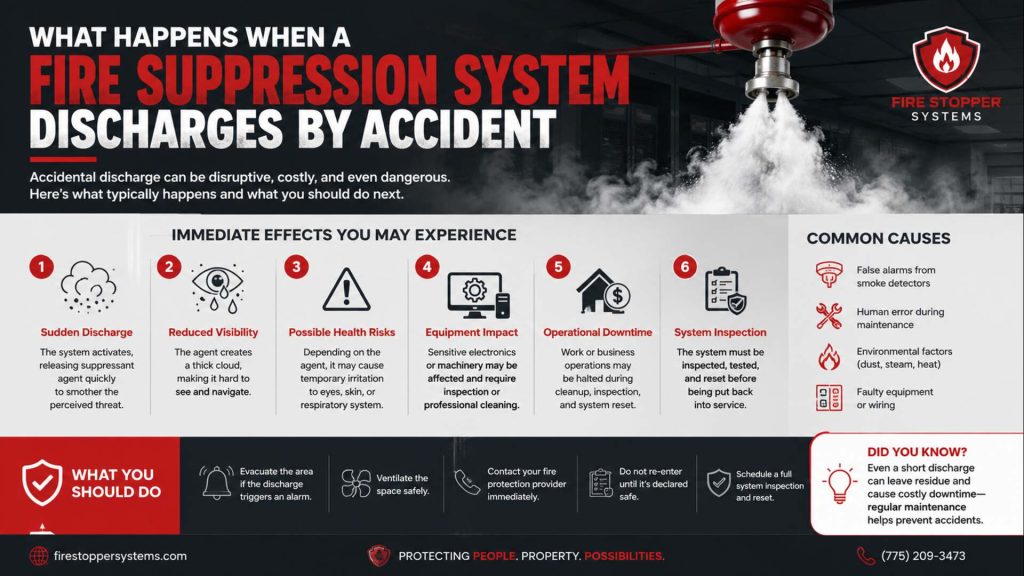
A fire suppression system firing off with no fire in sight is one of those moments that makes a facility manager’s stomach drop. The alarm sounds, the agent floods the enclosure, and suddenly everyone is asking the same question: was that supposed to happen?
Accidental discharges are more common than most business owners realize, and they’re rarely talked about openly. Manufacturers and installers tend to focus on how well a system stops fires, not on what happens when it goes off by mistake. But if you’re responsible for protecting CNC machines, electrical cabinets, or a production floor, understanding accidental discharge is just as important as understanding suppression performance itself.
This guide walks through why accidental discharges happen, what actually occurs when they do, how to respond, and, most importantly, how the right system design reduces the odds of it happening to you.
For business owners and facility managers, an unplanned discharge isn’t just an inconvenience. It can mean:
Understanding the mechanics behind accidental discharge helps you ask better questions before you buy, install, or maintain a suppression system, and it helps you respond calmly if it ever happens on your floor.
Before getting into what goes wrong, it helps to understand how these systems are supposed to work.
Most industrial fire suppression systems fall into two broad categories:
Fire Stopper Systems builds automatic fire suppression tubes engineered to activate reliably between 100°C and 120°C, operating at roughly 15 bar of internal pressure. Because there’s no control panel, wiring, or external power source required, there are fewer components that can fail. But that doesn’t mean accidental discharge is impossible. It just shifts the causes to a different, more predictable set of factors.
This is, in our experience, the single most common cause of an unplanned discharge in industrial settings. A tube or pipe run gets nicked during other maintenance work, brushed by a moving part, or crushed when something heavy is set down near it. Once the tube’s integrity is compromised, even normal ambient heat or pressure changes can cause it to fail at that weak point.
Lesson learned: Tubes routed too close to moving machinery components, sharp panel edges, or high-traffic maintenance zones are far more likely to be accidentally damaged. Proper clearance and routing during installation matters as much as the suppression technology itself.
Automatic fire suppression tubes are heat-activated by design. That’s the whole point. But if a tube is installed too close to a genuinely hot but non-fire heat source (certain welding operations, poorly ventilated engine compartments, or equipment that runs hotter than expected), it can reach the activation threshold without an actual fire event.
This is why professional installers map out a facility’s real operating temperatures, not just the equipment specifications, before finalizing tube placement.
For systems that rely on electronic detectors and control panels, a false discharge can come from:
This is one of the practical advantages of self-activating tube systems for smaller enclosures like electrical cabinets or CNC machine housings. There’s no control panel logic to misfire, because the tube itself is the detector and the delivery mechanism.
Improper installation is an underrated cause of accidental discharge. Common mistakes include:
Technicians working near a pressurized system without following lockout procedures can accidentally trigger a discharge, especially on systems with manual pull stations or test points that get bumped or mishandled.
Like any pressurized component, tubes and cylinders have a service life. Age-related wear, especially in facilities with high vibration or fluctuating temperatures, can eventually compromise materials that were originally installed correctly.
Understanding the sequence helps remove some of the panic if it happens on your watch.
(These recommendations reflect general industry best practice and Fire Stopper Systems’ field experience; they are not a substitute for a site-specific engineering assessment.)
It depends on the agent and the space. Clean agents used in tube-based systems are generally designed to be safe around electronics and personnel in the concentrations used for enclosure protection, but any discharge should be followed by proper ventilation and inspection, particularly with CO₂-based systems in confined spaces.
Most clean agents used in automatic fire suppression tubes are formulated to minimize residue and avoid the water damage associated with traditional sprinkler systems. Still, any electronics exposed to a discharge should be inspected before being powered back on.
Costs vary by tube length, agent type, and whether the burst point requires tube replacement versus a full system recharge. Your installer can provide an accurate quote based on your specific setup.
No fire protection system can guarantee zero risk of accidental activation, but proper installation, correct clearance from heat sources, and routine inspection significantly reduce the likelihood.
Tube-based systems eliminate many electronic failure points (wiring faults, control panel errors, sensor malfunctions) but are more sensitive to mechanical damage and thermal exposure at the tube itself. Each approach has different risk factors rather than one being universally “safer.”
Verify there’s no actual fire, ventilate the space per the agent’s safety guidance, shut down and inspect affected equipment, and contact your installer to identify the root cause before recharging.
Not necessarily. In many cases, the cause is external. Mechanical damage, excessive ambient heat, or an installation issue. rather than a defect in the tube or agent itself.
While tube-based systems generally require less maintenance than panel-based alternatives, a periodic visual inspection schedule (checking for kinks, abrasion, or pressure changes) is still recommended as part of routine facility maintenance.
An accidental discharge is unsettling, but it’s rarely a mystery once you understand the mechanics behind it. Whether it’s a tube nicked during unrelated maintenance work or a detector reacting to something other than fire, most causes trace back to installation, routing, or environmental factors that can be identified and corrected.
The bigger takeaway for business owners and facility managers is this: the fire suppression system you choose, and how carefully it’s installed, has a direct impact on how often you’ll deal with false activations. A well-routed, properly rated automatic fire suppression tube, installed with real attention to your facility’s actual heat sources and traffic patterns, is one of the most dependable ways to protect CNC machines and industrial equipment without adding electronic complexity to worry about.
If you’re evaluating fire suppression for CNC machines, electrical cabinets, or other high-risk equipment, Fire Stopper Systems can help you choose and install an automatic fire suppression tube sized and routed correctly for your facility, reducing both fire risk and the chance of an unplanned discharge. Contact Fire Stopper Systems today to get a site-specific recommendation.