
Are you struggling to choose the right fire protection for your sensitive equipment? You cannot afford to guess when it comes to facility safety. We understand that comparing different suppression technologies feels overwhelming. We are here to make that decision clear and factual.
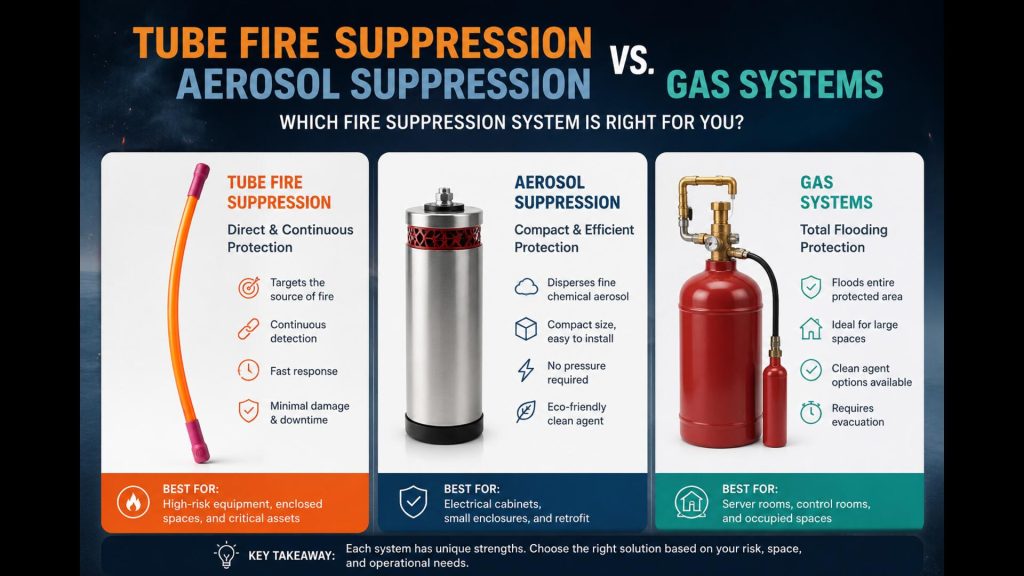
Tube fire suppression targets micro-environments like electrical panels directly. Aerosol works well for standalone enclosed rooms without external piping. Gas systems are ideal for large server rooms requiring clean, residue-free protection.
Now, let us break down the details of each technology. We will explore how they function. We will also compare their costs and maintenance requirements. This guide will help you protect your assets effectively.
First, we will look at tube-based technology. An automatic fire tube suppression system is a direct-release solution. It uses a heat-sensitive polymer tube. This tube acts as both a detector and a delivery method. It is highly reliable for critical applications.
The pressurized tube routes directly inside an enclosure. When a fire starts, the heat rises rapidly. The tube melts and bursts at the hottest point. It then releases the extinguishing agent exactly where the fire began. This happens in seconds.
These systems fit perfectly in small, enclosed spaces. We install them inside CNC machines and electrical panels. They also protect vehicle engine compartments and server racks. They do not require an external power supply to activate.
The main advantage is localized protection. You stop the fire at the specific source. This prevents the fire from spreading to the rest of the room. It also minimizes equipment damage. The automatic fire tube suppression system operates 24/7 without fail.
Next, we evaluate aerosol systems. Aerosol technology uses solid chemical particles to interrupt combustion. It does not displace oxygen or absorb heat like traditional methods. It acts purely on a chemical level. This is a highly modern approach to fire safety.
The aerosol unit activates and releases a fine cloud of particles. These micron-sized particles bind with the fire-causing free radicals. This chemical reaction breaks the fire chain instantly. The aerosol cloud remains suspended to prevent reignition for a long time.
Aerosol systems are very compact. They do not need complex piping networks or water supplies. You can mount them directly on walls or ceilings. They are excellent for marine engine rooms, remote telecom shelters, and battery storage containers.
Aerosol discharge leaves a visible particulate matter in the room. You must clean this dust up after a fire event. If left unattended, this residue can corrode sensitive electronics. Aerosol is not ideal for spaces with high-end IT servers.
Finally, we consider gas suppression systems. Gas systems use either clean agents or inert gases. Examples include Novec 1230, FM-200, and Carbon Dioxide. They require pressurized cylinders and extensive distribution piping. They are traditional, heavy-duty systems.
Clean agents cool the fire by absorbing heat energy. Inert gases lower the oxygen concentration in the room. This suffocates the fire without harming the equipment. Both methods work quickly to flood an entire space with gas.
Gas systems are built for total flooding applications. We see them in large data centers and medical imaging rooms. They protect control rooms and museum archives. They are necessary when you have a massive open space to secure.
Gas systems are expensive to install and maintain. They take up valuable floor space with large cylinder banks. You must make the room completely airtight for the gas to work. If a door is open, the gas escapes and fails.
Now we reach the core of our comparison. You need a side-by-side view to make an informed choice. A tube suppression vs aerosol vs gas system comparison reveals distinct differences. Let us analyze the five most critical factors for buyers in 2026.
Gas systems carry the highest initial purchase and installation cost. You must pay for extensive piping, large cylinders, and complex control panels. Aerosol systems cost significantly less upfront due to their standalone nature. An automatic fire tube suppression system provides the most cost-effective targeted protection.
Gas installations require specialized labor, extensive pipe fitting, and electrical wiring. This process can take weeks and disrupt your daily business operations. Aerosol units take only hours to mount and wire securely. Tube systems are also incredibly simple to install. You just route the flexible tubing around the specific hazard area.
Gas systems leave absolutely no residue behind after activation. This allows for immediate business continuity after a system discharge. Aerosol systems leave a fine particulate dust on all surfaces. This dust requires thorough cleaning and can be corrosive to electronics. Tube systems depend on the agent, but clean agent tubes leave zero residue.
Gas systems demand rigorous and expensive upkeep. You must schedule quarterly inspections, pipe pressure tests, and cylinder refills. Aerosol systems need minimal maintenance. A simple visual check is often enough for their long lifespan. An automatic fire tube suppression system also requires very little maintenance beyond checking the pressure gauge.
Gas systems consume valuable floor space with large cylinder banks. Aerosol units attach cleanly to the wall, saving room. However, the automatic fire tube suppression system wins for micro-enclosures. It fits directly inside the machine or cabinet where electrical fires actually start.
Next, we must consider the environmental impact of these systems. Environmental regulations change frequently in the United States. You want a system that remains compliant for years. Let us compare their environmental footprints.
Older gas systems used chemicals that harmed the ozone layer. Modern systems use clean agents like Novec 1230 or inert gases. These have a low global warming potential. They evaporate harmlessly into the atmosphere.
Aerosol systems are generally very eco-friendly. They do not deplete the ozone layer. They have a very low carbon footprint. The chemical compounds break down safely after they settle.
An automatic fire tube suppression system is highly targeted. It uses very small amounts of extinguishing agent. This minimal use is inherently better for the environment. You avoid flooding an entire room with chemicals.
Reliability is the most critical factor in fire protection. You need a system that activates instantly. Delayed activation leads to catastrophic equipment loss. Let us look at response times.
Gas systems rely on electronic smoke or heat detectors. When a detector trips, the control panel processes the signal. The panel then opens the cylinder valves. This process is fast, but it relies on complex electronics.
Aerosol units also use electronic detection or thermal triggers. Their activation is rapid once the trigger point is reached. However, the aerosol cloud takes time to fill a large room completely.
Tube systems offer the fastest localized response. The detection tube sits inches away from the potential fire source. It bursts immediately when exposed to direct flame. The automatic fire tube suppression system kills the fire instantly.
We want to help you plan your strategy effectively. Do not rush into a purchase decision. Take time to evaluate your specific hazard areas. Identify the equipment that is most critical to your business.
Look closely at your facility layout. Do you have room for large gas cylinders? If mechanical space is tight, gas is a poor choice. Aerosol and tube systems solve this space problem perfectly.
Never look only at the initial purchase price. Calculate the maintenance costs over a ten-year period. Gas systems will cost you thousands in mandatory inspections. Tube systems offer a much lower total cost of ownership.
We specialize in practical fire safety solutions. At Fire Stopper Systems, we strongly advocate for tube-based technology. Our American customers need reliable, cost-efficient protection. Tube systems stop fires at the source before they can spread.
They do not require electricity to function. This makes them fail-safe during severe power outages. They save you from installing expensive room-wide gas systems. You only protect the specific cabinets that pose a fire risk. This targeted approach is smart engineering.
Aerosol systems and automatic fire tube suppression systems share low installation costs. They completely eliminate the need for expensive piping networks. Gas systems are always the most expensive option available.
Aerosol systems leave a fine dust after a discharge. This dust can sometimes damage delicate computer boards if not cleaned quickly. For high-end servers, we prefer gas or clean agent tube systems.
No, they do not require any electricity. The rising heat from the fire melts the pressurized tube directly. This mechanical action releases the agent automatically. They provide true 24/7 standalone protection.
Gas cylinders can easily last for several decades. However, they require mandatory hydrostatic pressure testing every five to ten years. This adds significantly to the long-term cost of system ownership.